

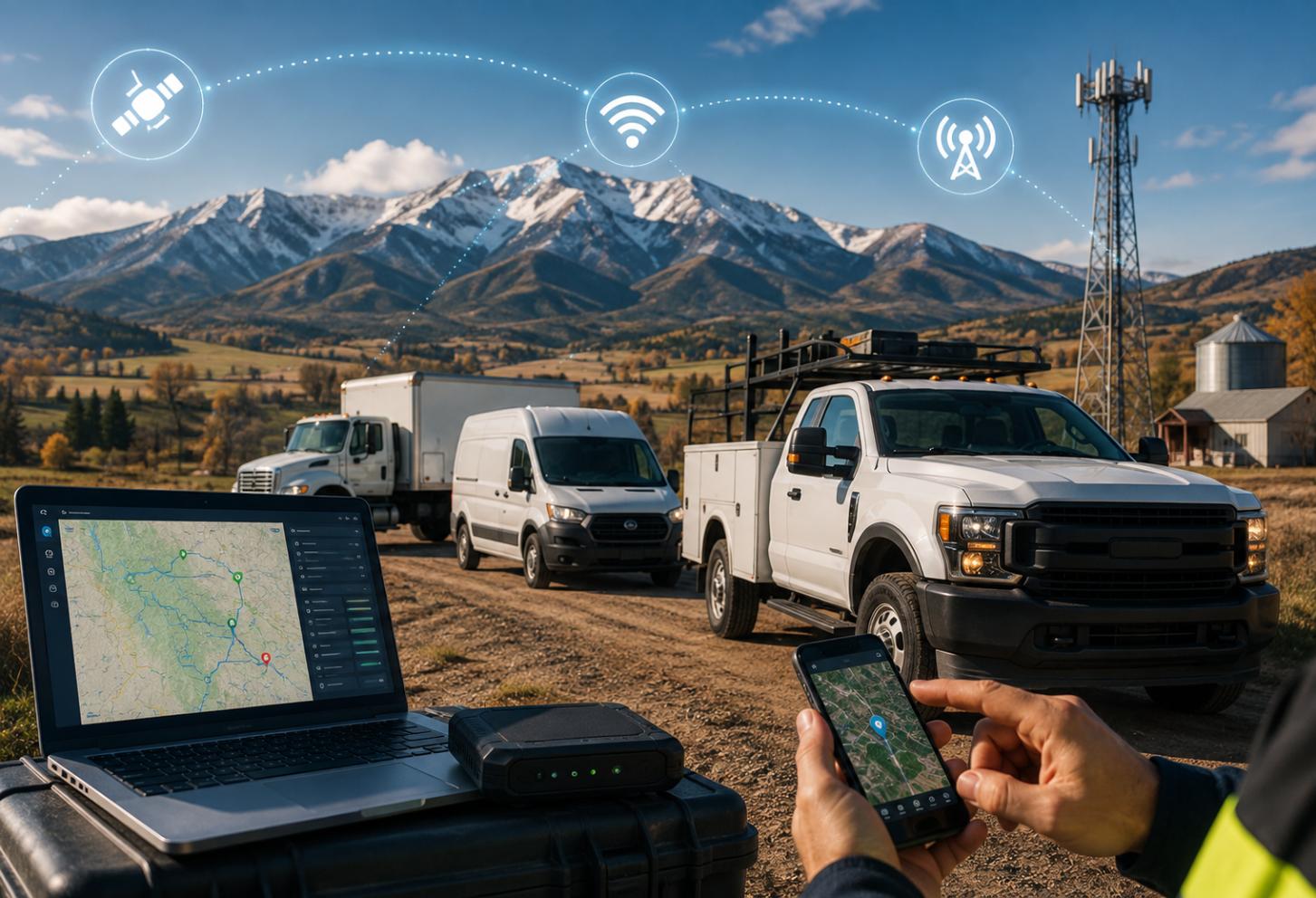
For field crews working across Northern Colorado, a normal workday can involve moving between Fort Collins job sites, Loveland customers, Windsor facilities, and more distant locations across Larimer County. Keeping vehicles, employees, dispatchers, and field data connected across that territory can become a significant operational challenge.
GPS fleet technology and mobile broadband can help businesses maintain better visibility into field operations while giving mobile employees reliable access to the information they need away from the office.
Quick answer: GPS fleet management helps businesses track vehicle location, improve dispatching, review routes, and understand how fleet resources are being used. Mobile broadband complements those capabilities by connecting field teams to cloud applications, work orders, communications, and other business systems while they are on the road. For Northern Colorado organizations with employees working throughout Fort Collins and surrounding communities, combining the two technologies can create a more connected field operation.
What Northern Colorado businesses should know
-
GPS fleet tools can give dispatchers greater visibility into where vehicles are located, making it easier to coordinate changing schedules and service calls.
-
Mobile broadband can keep crews connected while traveling between Fort Collins, Loveland, Windsor, and other Northern Colorado communities.
-
Better connectivity can reduce reliance on phone calls between field employees and office staff for routine updates.
-
GPS data can help managers identify inefficient routing, unnecessary mileage, and other patterns that deserve attention.
-
The right technology setup depends on fleet size, coverage requirements, applications, vehicles, and how employees actually work in the field.
Why Fleet Connectivity Matters in Northern Colorado
Fleet connectivity matters in Northern Colorado because field operations often cover a much larger area than a company’s home office or primary customer base. A crew dispatched from Fort Collins might have appointments elsewhere in Larimer County, along the Interstate 25 corridor, or in growing communities such as Timnath and Windsor during the same workday.
That geographic spread makes communication and visibility especially valuable. Dispatchers need to know which crew is positioned to respond efficiently, while employees need access to current job information without returning to the office.
Northern Colorado also presents changing driving and operating conditions throughout the year. Winter weather can affect travel times, while construction and continued development along major transportation corridors can complicate familiar routes.
Collins Communications Company serves businesses in this regional environment. We understand that communications technology for a mobile workforce needs to support what happens outside the office as well as what happens inside it.
How GPS Improves Fleet Management
GPS improves fleet management by giving businesses current vehicle-location information that can support dispatching, routing, accountability, and day-to-day operational decisions. Instead of relying entirely on calls or estimates about where a driver is located, managers can use fleet information to build a clearer picture of field activity.
For a Fort Collins service business, that visibility can be particularly useful when several crews are moving throughout the city and neighboring communities.
Depending on the system selected, GPS fleet technology may help a business evaluate:
-
Vehicle locations
-
Routes and trip history
-
Arrival and departure information
-
Vehicle utilization
-
Mileage and travel patterns
-
Driver activity supported by the selected platform
The goal is not simply to put dots on a map. Useful fleet information should help managers make better operational decisions.
How Mobile Broadband Supports Field Crews
Mobile broadband supports field crews by extending access to business communications and digital tools beyond a fixed office connection. With an appropriate mobile connectivity setup, employees can access supported applications and information from the field rather than waiting until they return to a Fort Collins office or shop.
For technicians, delivery teams, utility crews, contractors, and other mobile employees, connectivity may support digital work orders, scheduling systems, email, cloud applications, mapping, documentation, and communication with dispatch.
That can be valuable when a crew begins the morning near Old Town, travels south toward Loveland, and then receives another assignment elsewhere in Larimer County. Information can move with the crew rather than remaining tied to a desk.
Local Data and Operating Considerations
Northern Colorado’s combination of urban streets, interstate travel, expanding communities, and more distant service areas makes coverage planning an important part of mobile operations. A solution that performs well around central Fort Collins still needs to be evaluated against the actual territory where a company’s vehicles and employees travel.
Businesses should consider their normal routes rather than selecting technology based only on office connectivity. Areas around the I-25 corridor may represent one operating environment, while trips farther into Larimer County can present different connectivity considerations.
Because specific performance depends on equipment, carrier coverage, terrain, location, network conditions, and system configuration, businesses should evaluate mobile broadband based on their real operating footprint rather than assuming identical performance everywhere.
Warning Signs Your Fleet May Need Better Connectivity
A fleet may need better GPS or mobile connectivity when managers lack reliable visibility into vehicles, dispatchers spend too much time requesting updates, or employees struggle to access information away from the office. These problems can become more noticeable as a Fort Collins business expands its service territory.
Watch for signs such as:
-
Dispatchers repeatedly calling drivers to ask for their locations.
-
Crews receiving outdated job or scheduling information.
-
Employees returning to the office primarily to access or submit information.
-
Managers having limited insight into routing or vehicle utilization.
-
Customers waiting while office staff determine which crew is available.
-
Field employees depending on disconnected or inconsistent workflows.
-
Business growth making manual fleet coordination increasingly difficult.
Common Causes of Inefficient Field Operations
Inefficient field operations commonly result from limited vehicle visibility, disconnected information, manual dispatch processes, and communications systems that have not kept pace with business growth. For Northern Colorado companies, those issues can become more costly as the number of vehicles, employees, customers, and communities served increases.
A small fleet may initially function through phone calls and familiar routes. As operations spread from Fort Collins into Loveland, Windsor, Timnath, Wellington, and surrounding areas, that informal approach can become harder to manage.
Another common issue is treating GPS and connectivity as separate decisions. Location information is more useful when the people making dispatch decisions can communicate efficiently with the crews carrying out those decisions.
Preventing Fleet Communication Bottlenecks
Businesses can prevent many fleet communication bottlenecks by reviewing routes, applications, connectivity requirements, and dispatch workflows before problems become routine. The best time to evaluate these systems is often before fleet growth overwhelms an existing process.
Start by documenting where vehicles actually travel. Identify applications employees need during a normal shift, along with the information dispatchers need from the field.
Seasonal conditions deserve attention as well. Northern Colorado winter travel can change routes and arrival times quickly, making clear communication especially useful when conditions deteriorate.
Businesses should also periodically review whether their technology still fits their operation. Adding vehicles, expanding into new communities, or adopting new cloud applications can change connectivity requirements.
What Results Can Businesses Expect?
Businesses can realistically expect GPS and mobile broadband to provide better operational information and connectivity, but the results depend on how well the technology matches the fleet’s workflow and coverage needs. Technology cannot eliminate traffic, weather delays, scheduling conflicts, or every coverage limitation.
A properly planned system can make those challenges easier to manage. Dispatchers may have better information when assigning work, managers can review fleet activity more effectively, and employees can have improved access to supported business tools while mobile.
The practical objective is a field operation in which information moves more efficiently between vehicles, employees, and the office.
Common Fleet Technology Mistakes
Common fleet technology mistakes include choosing equipment without considering actual routes, focusing on features instead of workflows, and failing to plan for changing business needs. These mistakes can leave Northern Colorado businesses with technology that does not address their real operational problems.
Mistake: Selecting a system based only on the office location.
Consequence: Connectivity needs along regular field routes may be overlooked.
Better approach: Evaluate the complete operating territory.
Mistake: Collecting GPS data without deciding how it will be used.
Consequence: Managers receive information without gaining meaningful operational value.
Better approach: Identify specific dispatch, routing, or fleet-management goals first.
Mistake: Planning only for today’s fleet.
Consequence: A growing Fort Collins operation may quickly outgrow its setup.
Better approach: Consider foreseeable vehicles, users, applications, and service-area expansion.
A Common Northern Colorado Fleet Scenario
A common Northern Colorado scenario involves a service company with multiple vehicles leaving Fort Collins each morning for appointments throughout Larimer County and nearby communities. Dispatch begins with a planned schedule, but cancellations, urgent requests, traffic, and changing job durations quickly alter the day.
Without fleet visibility, dispatchers may need several phone calls to determine who can handle a new assignment. With appropriate GPS information, they can identify vehicle locations more efficiently. Mobile broadband can then help the selected employee receive updated digital information in the field.
This is a representative scenario rather than a Collins Communications Company case study, but it illustrates why location visibility and connectivity often work best together.
Related Fleet Communication Solutions
Related fleet communication solutions should connect vehicles and field employees with the information and communications resources needed to perform their jobs efficiently. GPS and mobile broadband can be part of that strategy, depending on the organization’s fleet, applications, coverage area, and operational requirements.
We can help businesses explore communications options based on how their teams work throughout Fort Collins and Northern Colorado.
Comparing GPS Alone With GPS and Mobile Broadband
GPS alone can improve vehicle visibility, while combining GPS with mobile broadband can support a broader connected-field strategy. The better choice depends on what information employees and dispatchers need to exchange during the workday.
A business primarily concerned with vehicle location may have different requirements than one whose technicians need access to cloud software, updated work orders, maps, or digital documentation.
Rather than adding technology for its own sake, start with the operational problem. Determine whether the priority is vehicle visibility, field connectivity, or both.
Service Areas
Our local focus includes Fort Collins and the broader Northern Colorado area, where fleets may regularly travel between communities rather than operating within one compact service zone. Businesses serving Loveland, Windsor, Timnath, Wellington, and other parts of Larimer County should evaluate technology against the routes their employees actually drive.
The Cost of Ignoring Fleet Inefficiency
Ignoring fleet inefficiency can lead to unnecessary mileage, slower dispatch decisions, communication gaps, administrative work, and reduced visibility into how vehicles are being used. For a growing Northern Colorado operation, small inefficiencies can become harder to manage as additional vehicles and service areas are added.
The purpose of improving fleet technology is not to create more data. It is to provide useful information and connectivity that help employees make better decisions.
Frequently Asked Questions
How can GPS help a Fort Collins service fleet?
GPS can help a Fort Collins service fleet by providing vehicle-location information that supports dispatching, routing, and fleet visibility. The exact capabilities depend on the platform, but the technology can reduce the need to rely solely on calls from drivers when managers need to understand where fleet resources are located.
Why would a Northern Colorado fleet need mobile broadband?
Mobile broadband can give Northern Colorado field employees access to supported digital tools while they are away from a fixed office connection. That may include scheduling systems, work orders, mapping, cloud applications, email, and other resources needed while crews travel between customer locations.
Does mobile broadband work everywhere in Larimer County?
Mobile broadband performance can vary across Larimer County based on carrier coverage, terrain, equipment, network conditions, and location. Businesses should evaluate the areas where their vehicles actually operate, particularly when routes extend beyond developed urban corridors into more distant or terrain-affected locations.
Can GPS help reduce unnecessary driving around Fort Collins?
GPS information can help managers identify routing and travel patterns that may reveal opportunities to reduce unnecessary driving around Fort Collins. Actual results depend on dispatch practices, customer locations, traffic, schedules, and how fleet data is used, so GPS should support operational decisions rather than be viewed as an automatic solution.
Should GPS and mobile broadband be planned together?
GPS and mobile broadband should be considered together when a business needs both vehicle visibility and connected field applications. GPS can provide useful location information, while mobile connectivity can support communications and digital workflows. Evaluating both needs at once can produce a more cohesive field technology strategy.
What businesses can benefit from connected fleet technology?
Businesses with employees and vehicles regularly working away from a central location may benefit from connected fleet technology. This can include service organizations, contractors, delivery operations, utilities, and other mobile workforces. The appropriate solution depends on fleet size, operating territory, applications, and communication requirements.
How should a growing Fort Collins company evaluate fleet technology?
A growing Fort Collins company should begin by documenting its current routes, number of vehicles, dispatch process, field applications, and communication problems. It should also consider likely expansion into surrounding Northern Colorado communities so the selected approach addresses future operational requirements as well as current ones.
When should we talk with a communications professional?
Businesses should consider professional guidance when they are unsure which equipment, connectivity approach, or system configuration fits their operating area. Professional planning can be especially helpful when vehicles travel throughout Northern Colorado and the organization needs to coordinate GPS, mobile connectivity, and existing business applications.
Build a More Connected Northern Colorado Fleet
GPS and mobile broadband can give local businesses better visibility and stronger connections between the office and the field. We can help you evaluate communication needs around your actual vehicles, routes, employees, and Northern Colorado operating environment.
Keep Your Field Teams Connected and Informed
Build a fleet communications strategy around how your crews actually work, with solutions selected for your operational requirements.