

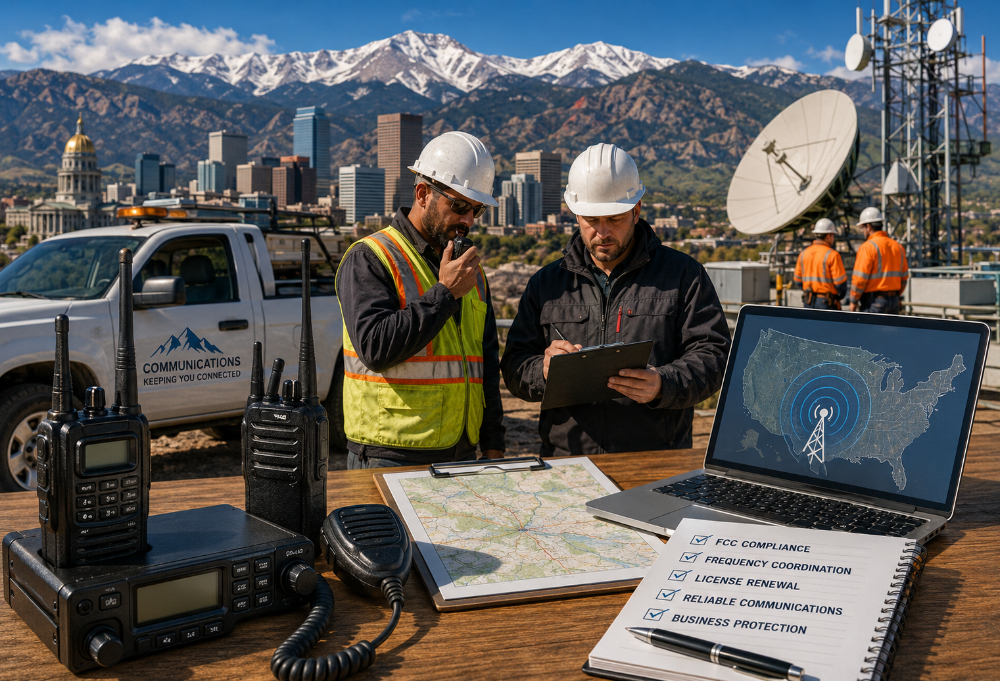
Whether you operate a fleet of delivery vehicles in Colorado, manage a construction site, or run a hospitality operation, understanding FCC radio license requirements is not just a technicality. It is a legal obligation that protects your operations, your employees, and your customers.
This guide breaks down what FCC licensing actually means, why it matters, and how to navigate the process with confidence.
Understanding the FCC and Its Role in Business Communications
The Federal Communications Commission, better known as the FCC, is the United States government agency responsible for regulating interstate and international communications by radio, television, wire, satellite, and cable. For businesses that use two-way radios or any other form of wireless transmission, the FCC serves as the governing body that assigns and manages the radio frequency spectrum.
The radio frequency spectrum is a finite resource. Without proper oversight, multiple businesses operating on the same frequencies would create constant interference, making reliable communication nearly impossible. The FCC licensing system exists to prevent that chaos by assigning specific frequencies to specific users, ensuring that your transmissions stay clean, clear, and legally protected.
When your business holds a valid FCC license, you are granted the exclusive right to operate on a designated frequency within a defined geographic area. This means competitors, neighboring businesses, and other operators cannot legally interfere with your communications. In industries where clear communication can mean the difference between safety and serious risk, that protection carries enormous value.
FCC Radio License Requirements: What You Need to Know
Navigating FCC radio license requirements can feel overwhelming at first glance, but understanding the basics makes the process far more manageable. Not every radio device requires a license. Consumer-grade walkie-talkies operating on low power under Part 95 of the FCC rules, for example, are generally license-free. However, most professional-grade business radios fall under Part 90, which governs private land mobile radio services, and these do require a license.
To obtain a license under Part 90, businesses must submit an application through the FCC’s Universal Licensing System, commonly referred to as the ULS. The application requires specific technical information about your radio equipment, including the type of station, the frequencies you intend to use, the transmitter power output, and the geographic area you plan to cover.
One of the most critical aspects of the application process is frequency coordination. Before submitting your application, you are typically required to work with an FCC-certified frequency coordinator who evaluates available frequencies in your area and recommends options that minimize the risk of interference with existing licensees. This step is especially important in densely populated regions and busy commercial corridors where the spectrum can get crowded.
FCC licenses are generally issued for a ten-year term and must be renewed before they expire. Operating with an expired license carries the same legal consequences as operating without one, so tracking renewal deadlines is a responsibility that businesses cannot afford to ignore. Violations can result in monetary fines, equipment seizure, and in serious cases, criminal penalties.
Why Colorado Businesses Have Unique Licensing Considerations
Businesses operating in Colorado face a distinct set of challenges when it comes to FCC licensing support and radio communication planning. The state’s geography is unlike almost anywhere else in the country. From the dense urban core of Denver to the remote mountain passes of the Rockies, Colorado businesses often operate across dramatically different terrain types, each presenting its own communication hurdles.
In mountainous regions, radio signals can be blocked, reflected, or distorted by terrain features. Businesses that rely on two-way radio communications in these environments often need to invest in repeater systems, which amplify and retransmit signals to extend coverage range. Each repeater system requires its own FCC license, adding another layer of complexity to the licensing process.
Colorado is also home to a wide range of industries that depend heavily on radio communications. Agriculture operations in the Eastern Plains, ski resort management along the Front Range, oil and gas extraction in the Western Slope, and transportation logistics throughout the state all rely on licensed radio frequencies to coordinate their workforces. For these businesses, disruptions to radio communication are not just inconveniences. They are operational and safety risks.
This is why many Colorado businesses turn to professional FCC licensing support services. Working with an experienced licensing consultant helps businesses identify the right frequencies, complete technical applications accurately, and stay in compliance with ongoing regulatory requirements. The investment in professional guidance typically pays for itself many times over when you consider the cost of violations or communication failures.
Business Radio Licensing: The Compliance Angle
Beyond the practical benefits of clear communication, business radio licensing is fundamentally a compliance matter. The FCC takes unauthorized use of the radio spectrum seriously, and enforcement actions are not hypothetical. The agency regularly monitors the airwaves and investigates complaints from licensed users who detect interference from unlicensed operators.
For small and mid-sized businesses, the compliance angle is particularly important. Large corporations often have dedicated communications or legal teams to manage their FCC obligations. Smaller operations, however, may not realize they are out of compliance until they receive a notice of apparent liability from the FCC. At that point, the cost of resolving the issue can far exceed what proper licensing would have cost from the beginning.
There is also the matter of due diligence. If your business is ever sold, merged, or audited, having clean and current FCC licenses is a sign of operational professionalism. Buyers and investors pay attention to these details, and a gap in compliance can raise red flags during the due diligence process.
Additionally, if your business works with government agencies, public safety organizations, or large enterprise clients, holding proper FCC licenses may be a contractual requirement. Failing to maintain current licensing could put those relationships and contracts at risk.
How to Get FCC Licensing Support for Your Business
Getting the right FCC licensing support starts with understanding where you currently stand. If you are already using business radios, the first step is auditing your existing equipment and verifying whether your licenses are current, accurate, and properly tied to the equipment you are operating. Many businesses discover during this process that their licenses have lapsed, cover the wrong frequencies, or are registered under outdated business information.
Once you have a clear picture of your current status, you can begin the process of updating, renewing, or applying for new licenses as needed. Working with a qualified FCC licensing consultant or frequency coordinator streamlines this process considerably. These professionals understand the technical language of FCC applications, know how to navigate the ULS efficiently, and can advocate on your behalf if questions or complications arise.
For businesses in Colorado and across the country, the goal of FCC licensing support is not just to check a compliance box. It is to build a communication infrastructure that is reliable, legally protected, and positioned to grow with your business. As your operations expand into new geographic areas or you add new radio equipment, your licensing needs will evolve. Having a trusted partner in that process ensures you stay ahead of your obligations rather than scrambling to catch up.
Conclusion
FCC licensing is not a bureaucratic inconvenience. It is the foundation of reliable, protected business communication. Whether you are navigating FCC radio license requirements for the first time or looking to strengthen your existing compliance posture in Colorado, understanding the system and working with the right FCC licensing support can make all the difference. Take the time to get your licenses in order, and your business communications will be clearer, more secure, and built on solid legal ground.
Need a Satellite Communication Service Near You?
At Collins Communications Company, we’re proud to be your trusted local partner in keeping your world connected. Since 1986, our family-owned business has been dedicated to providing reliable, innovative communication solutions across Fort Collins and beyond. Whether you need expert system design, equipment leasing, FCC licensing assistance, or professional installation and maintenance of Radio Systems, Public Safety DAS, Microwave, and Satellite Links — we’re here to help. With two full-service radio shops, a large fleet of rental radios, and a passion for supporting our community, we’re ready to meet your communication needs. Reach out to us today and let’s enhance your communication capabilities together!